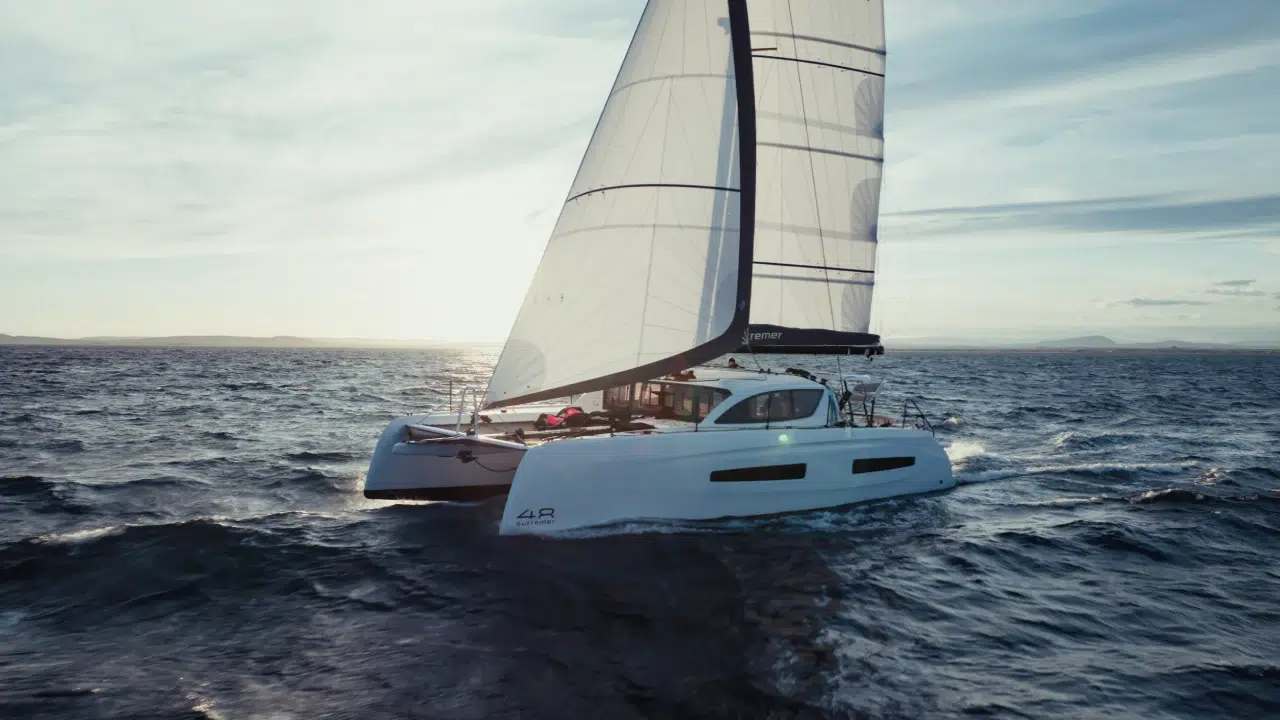
SailCharge, hybrid propulsion for fast bluewater catamarans
Power generated by sailing
Hybrid propulsion. Built for fast hulls.
A fast hull sails where others motor. Every hour under sail is an hour without fuel, and an hour when the propeller puts energy back.
On a fast bluewater catamaran, the propeller puts back part of what the boat spends.
The problem worth solving
Everything has improved except the noise
Hulls are faster, sails easier to handle, electronics more dependable. But leaving harbour, the night at anchor and the flat calm are still paid for at the same price: an engine running, a smell, a vibration through the hull, a conversation put off until later.
A fast hull sails where others motor. The propeller takes its power from the boat, so generating means slowing a little. The gain of a fast hull is not power in the hour, it is the number of hours.
Three more things you will notice about SailCharge
No gas bottle to hunt down
The galley is electric. Nothing to store, no flame, and no hunting for a fitting that matches yours at the far end of a passage.
Less to look after
Two full diesel engines and their gearboxes give way to saildrives and a single generator. Composite leg, no anodes, integrated rope cutter.
Power to live on
Forty-eight volts divides the current by four against a twelve-volt system: induction cooking, air conditioning and watermaker live on one system, and it stays serviceable in any port you reach.
What the boat puts back
Conservative and realistic figures
Regenerated power, both motors combined, based on real sailing conditions:
- 500 W at 6 knots
- 2 kW at 8 knots
- 3 kW at 10 knots
What we would rather write ourselves
Regeneration costs speed
The propeller takes its power from the boat: a few tenths of a knot when she is moving well, more at low speed. You are the one who decides, at the lever.
The generator runs when you motor
On batteries alone, motoring is counted in hours, not days: one to two at cruising speed. Beyond that, the generator runs. It stays silent at anchor.
Silence has a perimeter
We remove the noise of the engine and of the generator. The sea goes on talking.
Test it yourself
Come and try it at sea
Two hours to half a day at sea, aboard a boat fitted with the system, following these three moments in order. You leave with the log of your own passage: the miles you sailed and the fuel still in your tank.
Technical partner
Oceanvolt – Electric propulsion for boats
Several hundred systems in service worldwide, with an international service network.